
'This incident offers ammunition to those inside the US government and elsewhere who question the wisdom of trusting India, so it will have a lasting consequence no matter how it is managed.'

It is easy to foretell that negotiating a comprehensive and final agreement on the Iran nuclear issue is by no means an easy task. It involves hard negotiations, but the hardest step has been taken, says Ambassador M K Bhadrakumar, who was among the first group of foreigners to visit the the top-secret Arak plant hidden behind barren mountains south of Tehran.

State Bank of India, the nation's largest lender, has stopped processing transactions of Russian entities that have been sanctioned by the West over Moscow's invasion of Ukraine, sources said. To effect this, SBI has issued a circular as it fears that any transaction with entities or sectors under sanction will invite sanction on it as well, sources said. No transactions involving entities, banks, ports or vessels appearing on a US, European Union or United Nations sanctions list would be processed irrespective of the currency of the transaction, they said. Payments due to such entities have to be processed by other mechanism rather than through the banking channel, sources added.
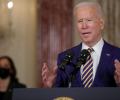
In his maiden address to the employees of the State Department, the US president said he has come to the building to send a clear message to the world: America is back. America is back. Diplomacy is back.

The further expansion and upgrade of the Chinese military does not augur well for India, which continues to confront an increasingly belligerent China on its borders, notes former foreign secretary Shyam Saran.
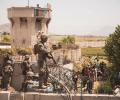
Like China, India too should connect the dots and move ahead with a long-term perspective in Afghanistan, advises Ambassador M K Bhadrakumar.

The prime minister said Iran needs time to come out with its detailed response as it had "several elements" in its administration.
Clinton, who lost to President Donald Trump in the 2016 elections, claimed that both Russia and China are benefitting from his weak foreign policy.

India would not be seen to be anything but rude with the Pakistanis. In the big picture, who is the bigger adversary right now? Who is the bigger pain in the neck? And who is it that is keeping more than 3,000 km of our borders active, throwing our military posture and deployments into imbalance? asks Shekhar Gupta.

Ahead of his crucial talks with Russian President Vladimir Putin in Moscow, Chinese President Xi Jinping said on Monday that his peace plan to end the raging Ukraine war takes into account the 'legitimate' concerns of all parties and reflects the broadest common understanding of the international community.
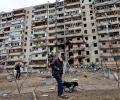
Now, as before, India's vote at the UN was dictated by paramount national interests. Though the Indian vote was 'neutral', its explanation was explicit in its criticism of the Russian actions. India took back with the left hand what it had given with the right, explains Ambassador T P Sreenivasan.
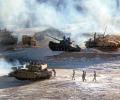
'The Chinese are only about 160-170 km behind.' 'It will not take much time for them to bring their troops back, considering that they have better infrastructure -- and the weather is now favourable.' 'They can move in much faster as the terrain favours them.'

The Taliban is showing its strong discontent as the high hopes given to it by the Pakistani military have been dashed, observes Ambassador M K Bhadrakumar.

Kim Jong-un declared he would never surrender North Korea's nuclear weapons weapons even if his country faced 100 years of sanctions. Dr Rajaram Panda explains Pyongyang's new nuclear doctrine that makes the world a much more dangerous place.

Unless the Taliban goofs up in a big way, which seems highly unlikely, we are looking at a regime that will be around for quite a long while and present a level of governance that the puppets of the richest and most advanced countries failed to provide, predicts Ambassador M K Bhadrakumar.

After two decades, the SCO appears to be at a cross-roads with the US withdrawal from Afghanistan, asserts Srikanth Kondapalli, the leading China expert.

The ineptness of successive American presidents, from Bush the Younger to Joe Biden the Old, combined with the cluelessness that Americans demonstrate in foreign lands, contrasts with the Chinese leadership's seemingly singular focus on the accumulation of wealth and power, asserts T N Ninan.

With Modi's international image seriously damaged -- perhaps, irrecoverably -- and Indian foreign policy finding itself in drift, we move on to the New Year in a depressing scenario, points out Ambassador M K Bhadrakumar.

'China was a relationship from which Mr Modi had expected the most it seems.' 'It showed in a string of summits, and somewhat breathless celebration of Xi Jinping.' 'It was hasty and simplistic,' observes Shekhar Gupta.

India has maintained communication with both Russia and Ukraine. It is time Narendra Modi steps up on the world stage and plays the role of peacemaker, suggests military historian Colonel Anil A Athale (retd).
The United States will continue to focus on the Asia-Pacific region and shape a future of greater security, President Barack Obama said on Wednesday, even as he vowed to veto any Congressional bill imposing new sanctions on Iran to give "diplomacy a chance to succeed".
Following the recent declassification of 70,000 files, the ministry of external affairs is in the process of finalising a major project to declassify another set of 220,000 files-records covering Afghanistan, Bangladesh, Bhutan, Pakistan, Iran and Sri Lanka, East Asia, Eurasia and the Americas

A day after Dhaka was liberated on December 16, 1971, then US President Richard Nixon was told by his strategic advisor Henry Kissinger that he had 'saved West Pakistan,' according to confidential papers since declassified by the US department of state.

'While the US-Pakistan relationship has been stabilised, it's still mired in uncertainty.'

Republican presidential candidate Mitt Romney plans pursue a more aggressive policy toward the Middle East, sharply different from that of United States President Barack Obama on Iran, Syria and Libya.

Considering that Qatar is a trusted ally of Washington for decades, it is expected to be a steady influence on the Taliban leadership, observes Ambassador M K Bhadrakumar.

Imran Khan knows Pakistan is holding a strong hand and doesn't have to flaunt it while claiming victory. But Pakistan has learned from the experience of the 1990s -- high risk of going out on a limb, asserts Ambassador M K Bhadrakumar.

Both statesmen possess a cultivated pugnacious style which they keep in reserve and can at will bring into play, and despite the mutual distrust in Russian-American relations, they are proponents of detente, quintessentially, who take their mission deadly seriously, points out Ambassador M K Bhadrakumar.
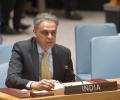
'It must be rendering Modi, Amit Shah and Adityanath speechless that the Indian diplomat who lifted the Azhar trophy at the UN in New York is also a Muslim. 'Yes, this is the wonder that was India,' says Ambassador M K Bhadrakumar.
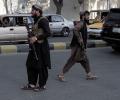
'Even during the worst days during the 1990s, India was dealing with the Taliban.'
'President Karzai's visit is an occasion to refine our thinking apropos the 'reintegration' and reconciliation strategy toward the Taliban.'

Pakistan, however, has categorically dismissed as 'utter fabrication' the report published in the newspaper.
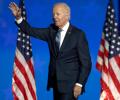
'The hardliners in Delhi are in for a big disappointment,' predicts Ambassador M K Bhadrakumar.

General Naravane's UAE and Saudi Arabia visits communicate India's long awaited arrival in the domain of integrated foreign policy where the diplomatic and the military domains both complement each other much more substantially, observes Lieutenant General Syed Ata Hasnain (retd).
"What I am going to restate is a basic principle. Number one, if a country is attacked, it has the right to defend itself. I think that is universally acknowledged," Obama asserted. "The second thing is that we need a strategic partnership with all the parts in the region -- Pakistan and India and the Afghanistan government -- to stamp out militant, violent, terrorist extremists."

The US is not going to be able to mount a concerted 'Western strategy' against China or Russia in the present international milieu, predicts Ambassador M K Bhadrakumar.

This visit has ended on a vastly different note in comparison with Modi's previous visits. Call it a rebuke, call it a censure, call it a distancing from Modi, the sharp message would have gone home, observes Ambassador M K Bhadrakumar.
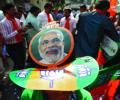
Retired senior US diplomats Teresita and Howard Schaffer believe the 'US cannot afford to continue restricting its contacts with Narendra Modi.' Rediff.com's Aziz Haniffa reports from Washington, DC.

Shehbaz, the younger brother of former three-time prime minister Nawaz Sharif, received 174 votes -- two more than the simple majority of 172.
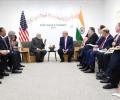
'The change of vocabulary in the India-US conversation was significant and refreshing.' 'It matched the styles of Trump and Modi.' 'The differences were not papered over, but there was determination to resolve them in the days ahead,' says Ambassador T P Sreenivasan.
